
Search results (1240 results)
-
 RPE - Rest In Peace (RIP)
Dec 17 2025 by SHRADDHA RAJ SHRIVASTAVA
Right eye pseudocolor fundus photo of a 50 year old patient, known case of bilateral familial dominant drusens with right eye CNVM, having undergone multiple intravitreal anti-VEGF injections. Image shows a CDR of 0.3:1, with numerous drusens at macula with residual lipid exudation from CNVM, along the infero-temporal arcade. Temporal to the fovea, we can see a vertical hyperpigmented line corresponding to retracted and redundant torn Retinal pigment epithelium, leaving behind a well circumscribed area of depigmented fundus with bare Bruch's membrane underlying the retina, findings suggestive of an RPE tear post multiple intravitreal injections.
Photographer: Dr. Shraddha Raj Shrivastava
Imaging device: Nidek Mirante SLO/OCT (Confocal scanning/Spectral domain OCT)
Condition/keywords: choroidal neovascular membrane (CNVM), Doyne's Honeycomb, FAMILIAL DOMINANT DRUSEN, lipid exudation, retinal pigment epithelium, RPE Rip
-
 RPE - Rest In Peace (RIP)
Dec 17 2025 by SHRADDHA RAJ SHRIVASTAVA
Multimodal imaging of Right eye of a 50 year old patient, known case of bilateral familial dominant drusens with right eye CNVM, having undergone multiple intravitreal anti-VEGF injections. The various imaging modalities highlight the presence of an extrafoveal RPE tear - post multiple intravitreal injections.
Photographer: Dr. Shraddha Raj Shrivastava
Imaging device: Nidek Mirante SLO/OCT (Confocal scanning/Spectral domain OCT)
Condition/keywords: FAMILIAL DOMINANT DRUSEN, multimodal imaging, retinal pigment epithelium, RPE-Rip
-
 RPE - Rest In Peace (RIP)
Dec 17 2025 by SHRADDHA RAJ SHRIVASTAVA
Right eye RETRO mode fundus image of a 50 year old patient, known case of bilateral familial dominant drusens with right eye CNVM, having undergone multiple intravitreal anti-VEGF injections. Among other findings, this novel imaging technique highlights the presence of an extrafoveal RPE tear - post multiple intravitreal injections.
Photographer: Dr. Shraddha Raj Shrivastava
Imaging device: Nidek Mirante SLO/OCT (Confocal scanning/Spectral domain OCT)
Condition/keywords: choroidal neovascular membrane (CNVM), Doyne's Honeycomb, FAMILIAL DOMINANT DRUSEN, lipid exudation, retinal pigment epithelium, RPE Rip
-
 RPE - Rest In Peace (RIP)
Dec 17 2025 by SHRADDHA RAJ SHRIVASTAVA
Right eye G-FAF photo of a 50 year old patient, known case of bilateral familial dominant drusens with right eye CNVM, having undergone multiple intravitreal anti-VEGF injections. Fundus autofluorescence better highlights the area of RPE tear in right eye (temporal to fovea), which shows hypoautofluorescence due to lack of RPE and its pigments which accounts for autofluorescence signal. Whereas the linear hyperautofluorescence, represents the torn bunched up retinal pigment epithelium.
Photographer: Dr. Shraddha Raj Shrivastava
Imaging device: Nidek Mirante SLO/OCT (Confocal scanning/Spectral domain OCT)
Condition/keywords: choroidal neovascular membrane (CNVM), Doyne's Honeycomb, FAMILIAL DOMINANT DRUSEN, lipid exudation, retinal pigment epithelium, RPE Rip
-
 Cracking the Angioid Streaks Mystery
Nov 26 2025 by SHRADDHA RAJ SHRIVASTAVA
Left eye pseudocolor fundus photo showing hyperpigmented irregular lines emanating from the disc in a radiating fashion. Surrounding the angioid streaks and at the posterior pole, we can see numerous dot-like hypopigmented deposits along with a grayish-green membrane with exudates at the macula. The image is suggestive of Angioid Streaks with CNVM.
Photographer: Dr. Shraddha Raj Shrivastava
Imaging device: Nidek Mirante SLO/OCT (Confocal scanning/Spectral domain OCT)
Condition/keywords: Angiod streaks in Pseudoxanthoma elasticum, Angioid Streaks, Bruch's membrane, choroidal neovascular membrane (CNVM), color fundus photograph, pseudoxanthoma elasticum (PXE)
-
 Cracking the Angioid Streaks Mystery
Nov 26 2025 by SHRADDHA RAJ SHRIVASTAVA
G-FAF image of left eye better reveals more extensive hypoautofluorescent streaks than might be apparent on standard fundus photo. Characteristic “Para-streak phenomenon” of focal hyperautofluorescent spots are seen along the margins of the dark angioid streaks, corresponding to the areas of pigment clumping seen clinically.
Photographer: Dr. Shraddha Raj Shrivastava
Imaging device: Nidek Mirante SLO/OCT (Confocal scanning/Spectral domain OCT)
Condition/keywords: Angiod streaks in Pseudoxanthoma elasticum, Angioid Streaks, choroidal neovascular membrane (CNVM), fundus autofluorescence (FAF), pseudoxanthoma elasticum (PXE)
-
 Cracking the Angioid Streaks Mystery: Multimodal Mayhem
Nov 26 2025 by SHRADDHA RAJ SHRIVASTAVA
Multimodal imaging of right eye fundus showing Angioid Streaks with scarred CNVM. Color fundus photo shows hyperpigmented irregular lines emanating from the disc in a radiating fashion. Surrounding the angioid streaks and at the posterior pole, we can see numerous dot-like hypopigmented deposits and a disciform scar at macula. G-FAF images better reveal more extensive hypoautofluorescent streaks than are apparent on standard fundus photo. Characteristic “Para-streak phenomenon” of focal hyperautofluorescent spots are seen along the margins of the dark angioid streaks, corresponding to the areas of pigment clumping seen clinically. The para-streak pigment clumps are better delineated on the novel Retro-imaging method, appearing as raised bumps surrounding the angioid streaks.
Photographer: Dr. Shraddha Raj Shrivastava
Imaging device: Nidek Mirante SLO/OCT (Confocal scanning/Spectral domain OCT)
Condition/keywords: Angioid Streaks, Bruch's membrane, disciform scar, fundus autofluorescence (FAF), multimodal imaging, retro mode
-
 Idiopathic CNVM
Sep 30 2025 by T. P . VIGNESH, MBBS,MS
SD-OCT of the left eye of 45 year old man with idiopathic CNVM.
Photographer: Sivanath
Imaging device: Heidelberg Spectralis
Condition/keywords: Idiopathic CNVM
-
 Idiopathic Choroidal Neovascularization
Sep 30 2025 by César Adrián Gomez Valdivia, MD
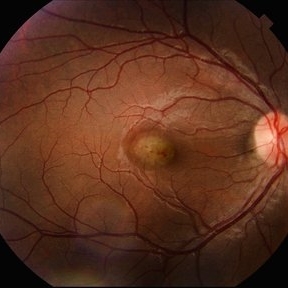
At the foveal area, there is a yellowish-greenish elevated lesion with indistinct borders, corresponding to a subfoveal choroidal neovascular membrane (CNV). There are subtle overlying changes including mild retinal pigment epithelium (RPE) disruption, and small hemorrhagic spots suggesting active leakage. Surrounding the lesion, there are faint retinal folds or striae, likely due to localized subretinal fibrosis or traction.
Photographer: @eyemissu2
Imaging device: TOPCON TRX
Condition/keywords: Idiopathic Choroidal Neovascularization
-
 Optic Disc Drusen
Aug 20 2025 by Drew Mitchell
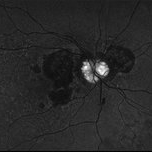
Fundus Autofluorescence photo of an 86 year old woman with neovascular AMD with active CNV and optic disc drusen.
Photographer: Drew Mitchell OCT-C
Imaging device: Optos California
Condition/keywords: fundus autofluorescence (FAF), neovascular age-related macular degeneration (AMD), optic disc drusen, OPTOS
-
 Optic Disc Drusen
Aug 20 2025 by Drew Mitchell
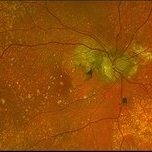
Optos color photo of a 86 year old woman with neovascular AMD with active CNV and optic disc drusen.
Photographer: Drew Mitchell OCT-C
Imaging device: Optos California
Condition/keywords: color photo, optic disc drusen, OPTOS
-
 Subretinal Neovascular Membrane
Aug 15 2025 by Akansha Sharma
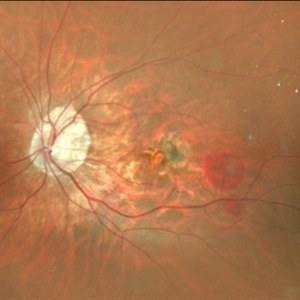
Color fundus photograph of a 40 year old male with subretinal neovascular membrane.
Photographer: DR. AKANSHA SHARMA
Condition/keywords: choroidal neovascular membrane (CNVM), CNVM, SRNVM, subretinal neovascularization (SRNV), wet age-related macular degeneration (wet AMD)
-
 Subretinal Neovascular Membrane
Aug 15 2025 by Akansha Sharma
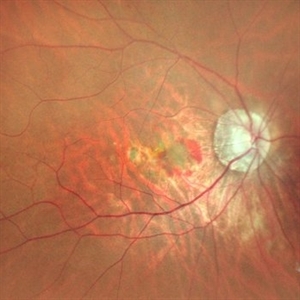
Color fundus photograph of a 40 year old male with subretinal neovascular membrane.
Photographer: DR. AKANSHA SHARMA
Condition/keywords: choroidal neovascular membrane (CNVM), CNVM, Myopic CNVM, SRNVM, subretinal neovascularization (SRNV), Wet age related macular degeneration
-
 Macular Mount Everest
Aug 8 2025 by Anand Temkar
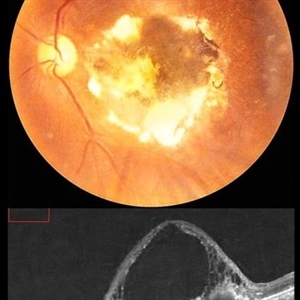
A 75 yrs old male came with the chief complains of DOV in LE since past 20 yrs. His BCVA in RE was 6/9 and in LE, it was CF 1 meter. His IOP was 13 mm of Hg in RE and 15 mm of Hg in LE. Patient is a k/c/o DM type 2 since past 20 yrs and is on regular medication. Patient is a k/c/o solitary kidney. Patient gives h/o ( LE ) Intravitreal injection Avastin 3 times 13 yrs ago i/c/o CNVM. In the LE color photo we can see the scarred CNVM along with altered foveal contour. LE OCT also shows cystic spaces with large elevation and scarring.
Photographer: Dr.Anand Temkar- Vasan Eye Hospital, Tiruchirapalli
Condition/keywords: CNVM, macular edema, scarred cnvm
-
 Pseudoxanthoma Elasticum
Aug 7 2025 by Alind Murkhe
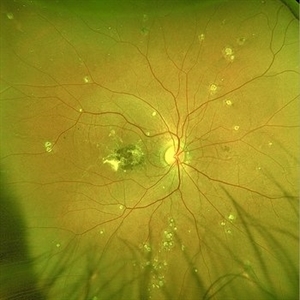
Fundus photograph of a 42 year-old male with pseudoxanthoma elasticum showing Angiod streak, scarred CNVM, Comet tails lesion.
Photographer: Dr Alind Murkhe, Nandadeep Eye Hospital, Sangli, Maharashtra, India
Condition/keywords: Angiod streaks in Pseudoxanthoma elasticum, CNVM
-
Subhyaloid Hemorrhage
Jul 14 2025 by SHRADDHA ASHOK CHANDORKAR, DNB DO FVRS
19 year old female presented with sudden blurring of vision in her right eye since few hours after she attended a DJ party the previous night. On examination Vision was counting fingers close to face and Retina showed Subhyaloid hemorrhage with some RPE damage. YAG hyaloidotomy was performed and the subhyaloid hemorrhage was drained. Need for injections if RPE damage and development of CNV in future was explained. Patient was apprehensive as the vision was not restored immediately after the blood was drained. On subsequent follow ups slowly patient’s vision was restored to 6/6N6 after about a month.
Condition/keywords: subhyaloid hemorrhage
-
 Subhyaloid Hemorrhage
Jul 12 2025 by SHRADDHA ASHOK CHANDORKAR, DNB DO FVRS
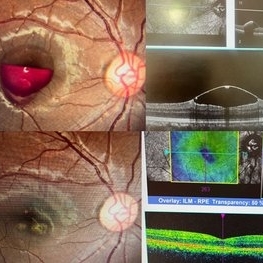
19 year old female presented with sudden blurring of vision in her right eye since few hours after she attended a DJ party the previous night. On examination Vision was counting fingers close to face and Retina showed Subhyaloid hemorrhage with some RPE damage. YAG hyaloidotomy was performed and the subhyaloid hemorrhage was drained. Need for injections if RPE damage and development of CNV in future was explained. Patient was apprehensive as the vision was not restored immediately after the blood was drained. On subsequent follow ups slowly patient’s vision was restored to 6/6N6 after about a month.
Photographer: Dr.Shraddha Chandorkar
Imaging device: Zeiss
Condition/keywords: subhyaloid hemorrhage
-
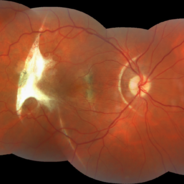 Post-traumatic Choroidal Rupture
Jun 20 2025 by Alexander Babaev
Fundus photograph of a 46-year-man with a choroidal rupture after blunt trauma, complicated CNV.
Photographer: Babaev Alexander, Saint-Petersburg, medical clinic "Vision"
Imaging device: Carl Zeiss Visucam 500
Condition/keywords: choroidal rupture
-
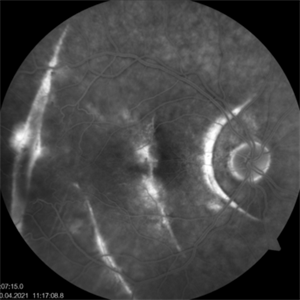 Post-traumatic Choroida Rupture-Fluorescein Angiography
Jun 20 2025 by Alexander Babaev
Fluorescein angiography of an 46-year-man with a choroidal rupture after blunt trauma, complicated CNV. 07.15, Dye leakage is visible along the edges of the rupture
Photographer: Babaev Alexander, Saint-Petersburg, medical clinic "Vision"
Imaging device: Carl Zeiss Visucam 500
Condition/keywords: blunt trauma
-
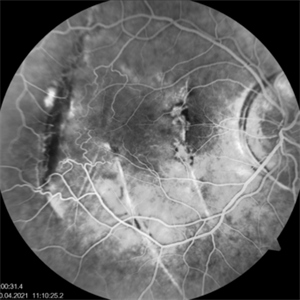 Post-traumatic Choroidal Rupture-Fluorescein Angiography
Jun 20 2025 by Alexander Babaev
Fluorescein angiography of an 46-year-man with a choroidal rupture after blunt trauma, complicated CNV. 00.31s, Dye leakage is visible along the edges of the rupture
Photographer: Babaev Alexander, Saint-Petersburg, medical clinic "Vision"
Imaging device: Carl Zeiss Visucam 500
Condition/keywords: fluorescein angiogram (FA)
-
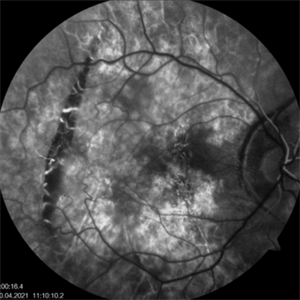 Post-traumatic Choroidal Rupture-Fluorescein Angiography
Jun 20 2025 by Alexander Babaev
Fluorescein angiography of an 46-year-man with a choroidal rupture after blunt trauma, complicated CNV. 00.16s
Photographer: Babaev Alexander, Saint-Petersburg, medical clinic "Vision"
Imaging device: Carl Zeiss Visucam 500
Condition/keywords: blunt trauma
-
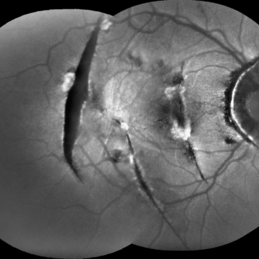 Post-traumatic Choroidal Rupture
Jun 20 2025 by Alexander Babaev
FAF
Photographer: Babaev Alexander, Saint-Petersburg, medical clinic "Vision"
Imaging device: Carl Zeiss Visucam 500
Condition/keywords: choroidal neovascularization (CNV), Choroidal rupture
-
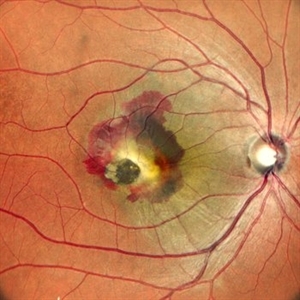 When the Macula Decides to Bleed... Artistically (Case of Macular Scar with Subretinal Bleed)
Jun 2 2025 by rohan jain
A case of 42 years old male. Color photograph showing macular scar with subretinal bleed.
Photographer: Dr. ROHAN JAIN
Imaging device: mirante
Condition/keywords: CNVM, macular scar, scar, subretinal hemorrhage, subretinal blood
-
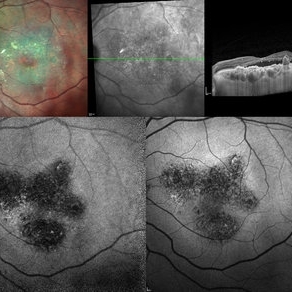 Multi-modal Imaging of Type - 1 CNVM
May 30 2025 by Shivankar Sen, MS, FVRS
Multimodal Imaging of a case of Polypoidal Choroidal Vasculopathy Multicolor Reflectance showing multiple green-hyper-fringent lesions in the macular region (Up Left) Infra-red Autofluorescence and Blue Autofluorescence showing hypo-autofluorescent areas correspondingly revealing the exact extent of the sub-RPE Lesion (Down left and right respectively) Optical Coherence Tomography - Enhanced Depth Imaging showing Thumb-shaped Pigment Epithelial Detachment with presence of Sub-retinal fluid and Hyper-reflective foci (Top Right)
Photographer: Dr. Shivankar Sen
Imaging device: Heidelberg Spectralis HRA+OCT
Condition/keywords: Blue autofluroscence, CNVM, multicolor, near infrared autofluorescence (NIRAF), PCV, reflectance
-
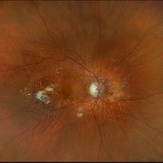 Neovascular AMD with Active CNV
May 22 2025 by Kimberly Wakester
Optomap RGB of an 82-year-old man with Neovascular AMD with Active CNV and Dry AMD in the right eye. There is advanced atrophic changes without subfoveal involvement located temporally to the fovea. Patient is to continue follow up care with dilated exam, repeat OCT, and treatment of intravitreal injection of Vabysmo every 5 weeks at this time.
Photographer: Kimberly Wakester, COA, OCT-C
Imaging device: Optos California
Condition/keywords: advanced geographic atrophy, dry age-related macular degeneration (dry AMD), neovascular age-related macular degeneration (AMD)
 Loading…