
Search results (11 results)
-
 Posterior Vitreous Detachment
Sep 1 2020 by J. Sebag, MD, FACS, FRCOphth, FARVO
Left: Preset lens biomicroscopy of PVD in the left eye of a subject with a widely dilated pupil. The detached posterior vitreous cortex is seen (arrows) as is the optic disc and retinal vasculature (upper left). (courtesy of C. L. Trempe MD, Harvard Medical School, Boston, MA) [Sebag J: Vitreous – in Health & Disease Springer, New York, 2014; image © Springer Nature, reprinted with permission] Right: B-scan ultrasonography of PVD images the detached posterior vitreous cortex with a visible Weiss Ring.
Condition/keywords: posterior vitreous detachment
-
 Age-Related Differences in the Structure of the Human Vitreous Body
Sep 1 2020 by J. Sebag, MD, FACS, FRCOphth, FARVO
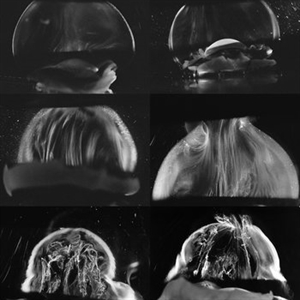
Dark-field slit microscopy was performed on fresh, unfixed, post-mortem human eyes that had undergone dissection to peel off the sclera, choroid, and retina. The vitreous body remains attached to the anterior segment which is seen below, while the posterior pole is above in these images. The top panel demonstrates the absence of internal vitreous structures that scatter light in youth (left image from an 11 year-old girl, right image from a 14 year-old boy. The middle panel demonstrates light scattering from linear, fibrous structures that have an antero-posterior orientation with insertions into the vitreous base peripherally and the posterior vitreous cortex, typical in middle age (left image from a 56 year-old and right image from a 59 year-old). The bottom panel illustrates advance fibrous liquefaction in old age (88-year-old subject). [From Sebag J, Niemeyer M, Koss M: Anomalous PVD and vitreoschisis. In: Vitreous – in Health & Disease (J. Sebag, ed.) Springer, New York, 2014, pg. 245; image © Springer Nature, reprinted with permission]
Condition/keywords: vitreous
-
 Folds in Detached Posterior Vitreous Cortex
May 31 2022 by Joshua Friedman
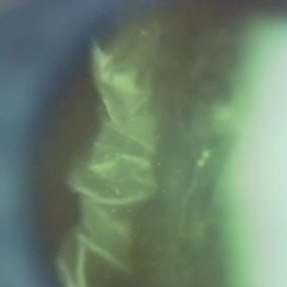
Slit lamp (video) image showing folds in the posterior vitreous cortex in an eye with PVD.
Photographer: Martin Snead, MD, Cambridge, England
Condition/keywords: folds, posterior vitreous cortex, PVD, vision degrading myodesopsia, vitreous
-
 Human Hyalocytes
Sep 1 2020 by J. Sebag, MD, FACS, FRCOphth, FARVO
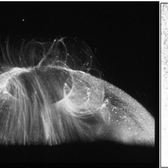
LEFT: Dark-field slit microscopy was performed on this fresh, unfixed, post-mortem human eye that had undergone dissection to peel off the sclera, choroid, and retina. The posterior pole is imaged in this image with vitreous extruding out the prepapillary hole in the posterior vitreous cortex (small, to right) and the premacular dehiscence (larger, to left). Bright light scattering is seen from punctate structures with the posterior vitreous cortex, corresponding to hyalocytes distributed in a monolayer. RIGHT: Transmission electron microscopy of human hyalocyte in situ demonstrates embedding of the hyalocyte within the dense collagen matrix of the posterior vitreous cortex. Mi = microvilli; black C = collagen of posterior vitreous cortex; N = lobulated nucleus typical of mononuclear phagocytes; white C = dense marginal chromatin in nucleus; M = mitochondria; V = vacuoles; arrows = dense granule (original magnification = 11,670) [From Sebag J: The Vitreous - Structure, Function, and Pathobiology. Springer-Verlag, New York, 1989; right 48, left pg. 50 (images © Springer Nature, reprinted with permission); right image courtesy of J. L. Craft and D. M. Albert, MD, Harvard Medical School, Boston, MA]
Condition/keywords: hyalocytes
-
 Lamellar Structure of the Primate Posterior Vitreous Complex
Sep 3 2020 by J. Sebag, MD, FACS, FRCOphth, FARVO
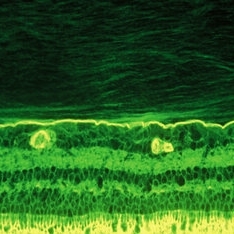
Immunohistochemistry of a monkey eye imaged with fluorescein conjugated ABA lectin staining demonstrates the lamellar structure pf the posterior vitreous cortex. During anomalous PVD, there can be splitting between these lamellae, a phenomenon known as vitreoschisis. (original magnification = 400x)
Condition/keywords: vitreous
-
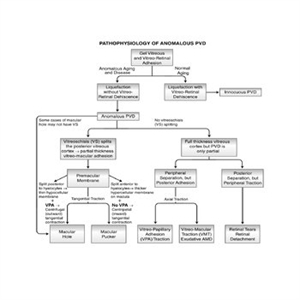 Pathophysiology of Anomalous PVD
Sep 1 2020 by J. Sebag, MD, FACS, FRCOphth, FARVO
This unifying concept of vitreo-retinopathies hypothesizes that the pathogenesis of several vitreoretinal diseases that were previously considered very disparate, are actually all manifestations of the same underlying pathophysiology – anomalous PVD. Note that vitreo-papillary adhesion (VPA) and traction can cause primary optic neuropathy, but might also play a role in facilitating/promoting cell migration and proliferation during pathologic neovascularization of the optic disc. Further, VPA seems to alter the vector of tangential forces exerted by a membrane, in some cases full-thickness posterior vitreous cortex and in some cases the outer layer of the posterior vitreous cortex left attached to the macula after vitreoschisis. While not all cases of macular holes have vitreoschisis, they feature vitreomacular adhesion and traction almost always with VPA. [From Sebag J: Anomalous PVD – a unifying concept in vitreo-retinal diseases. Graefe’s Arch Clin Exp Ophthalmol 2004;242:690-8 and Sebag J, Niemeyer M, Koss M: Anomalous PVD and vitreoschisis. In: Vitreous – in Health & Disease (J. Sebag, ed.) Springer, New York, 2014, pg. 252; image © Springer Nature, reprinted with permission]
Condition/keywords: pathology, peripheral vascular disease (PVD)
-
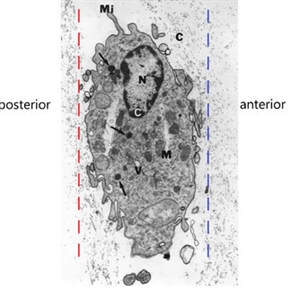 Pathophysiology of Vitreoschisis
Sep 1 2020 by J. Sebag, MD, FACS, FRCOphth, FARVO
Transmission electron microscopy of human hyalocyte in situ demonstrates embedding within the dense collagen matrix of the posterior vitreous cortex. The retina was to the left (“posterior”) and the anterior segment was to the right (“anterior”). The red dashed line indicates the level of vitreoschisis split that might occur posterior to the level of the hyalocyte monolayer, leaving a thin, hypocellular membrane attached to the macula. The dashed blue line indicates the level of vitreoschisis split that might occur anterior to the level of the hyalocyte monolayer, leaving a thick, hypercellular membrane attached to the macula. The former is more likely to present as macular hole, while the latter as macular pucker (see Figure 12). Mi = microvilli; black C = collagen of posterior vitreous cortex; N = lobulated nucleus typical of mononuclear phagocytes; white C = dense marginal chromatin in nucleus; M = mitochondria; V = vacuoles; arrows = dense granule (original magnification = 11,670) [Modified from Sebag J: Anomalous PVD – a unifying concept in vitreo-retinal diseases. Graefe’s Arch Clin Exp Ophthalmol 2004;242:690-8 and Sebag J, Niemeyer M, Koss M: Anomalous PVD and vitreoschisis. In: Vitreous – in Health & Disease (J. Sebag, ed.) Springer, New York, 2014, pg. 252]
Condition/keywords: pathology, vitreoschisis
-
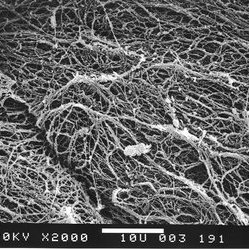 Scanning electron microscopy of the posterior aspect of the human posterior vitreous cortex
May 31 2022 by Joshua Friedman
Scanning electron microscopy demonstrates the dense packing of collagen fibrils in the posterior vitreous cortex. To some extent this arrangement is exaggerated by the dehydration that occurs during specimen preparation for scanning electron microscopy (bar = 10 µm).
Photographer: EM lab, Eye Research Institute of Retina Foundation, Boston, MA
Condition/keywords: collagen fibrils, posterior vitreous cortex, scanning EM, vision degrading myodesopsia
-
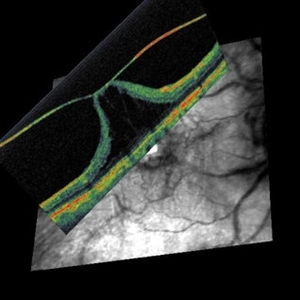 Vitreo-Macular Traction Syndrome
Sep 1 2020 by J. Sebag, MD, FACS, FRCOphth, FARVO
Combined OCT and Scanning laser ophthalmoscopy demonstrate separation of full-thickness posterior vitreous cortex (no vitreoschisis), but persistent adhesion centrally with significant detachment of the fovea. [from Sebag J: Vitreous – in Health & Disease (J. Sebag, ed.) Springer, New York, 2014; image © Springer Nature, reprinted with permission]
Condition/keywords: vitreomacular traction (VMT)
-
 Vitreoschisis
Sep 3 2020 by J. Sebag, MD, FACS, FRCOphth, FARVO
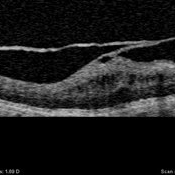
OCT of the left eye in a patient with macular pucker (see SLO image below to right) demonstrates splitting of the posterior vitreous cortex in two separate places. Tangential traction caused thickening of the underlying macula. [For histopathology see: Gupta P, Yee KMP, Garcia P, Rosen RB, Parikh J, Hageman GS, Sadun AA, Sebag J: Vitreoschisis in macular diseases. Brit J Ophthalmol 2011;95(3):376-80]
Condition/keywords: vitreoschisis
-
 Vitreous Structure in Youth
Sep 1 2020 by J. Sebag, MD, FACS, FRCOphth, FARVO
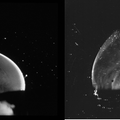
Dark-field slit microscopy was performed on fresh, unfixed, post-mortem human eyes that had undergone dissection to peel off the sclera, choroid, and retina. The vitreous body remains attached to the anterior segment which is seen below, while the posterior pole is above in these images. These horizontal optical sections demonstrate intense light scattering by the posterior vitreous cortex and the remnant of the hyaloid artery destined to be Cloquet’s Canal (left image), but no other light scattering within the vitreous body in either the 33 GW human fetus (left image) or this 6 year-old child (right image). [from Sebag J: The Vitreous - Structure, Function, and Pathobiology. Springer-Verlag, New York, 1989, left image pg. 77; right image pg. 79; images © Springer Nature, reprinted with permission]
Condition/keywords: vitreous
 Loading…