
Search results (6 results)
-
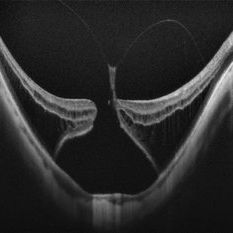 Myopic Traction Maculopathy
Mar 17 2025 by Drew Mitchell
HD 1 line 100x 9 mm scan of a right eye with MTM at stage 3c. Macular Schisis Detachment.
Photographer: Drew Mitchell OCT-C
Imaging device: Zeiss Cirrus 5000
Condition/keywords: full thickness macular hole, Macular hole, myopic foveoschisis, myopic macular schisis, myopic traction maculopathy, PVD
-
 Retinal Schisis Detachment
Nov 9 2012 by Norman Byer
This 57-year-old man has a combined retinal schisis detachment caused by an outer layer hole in the upper right. On the right half of this photograph, the outer layer is detached and represented by the prominent yellow line which is lying against the inner layer. On the left half the inner layer appears very thin and the schisis cavity lies just behind it as it was originally. This, therefore, represents a localized detachment of the outer layer and thus a true secondary retinal detachment. The reason these cases remain localized and nonprogressive is that the only fluid available to the subretinal space is that which is contained within the schisis cavity. Furthermore, this fluid tends to be quite viscous and is not readily passed through the retinal breaks. A clinical symptomatic progressive retinal detachment cannot occur unless the retinal schisis cavity is very large or a break occurs in the inner layer also.
Condition/keywords: intact inner layer, localized detachment of outer layer, outer layer hole, retinal schisis detachment, retinoschisis, secondary retinal detachment
-
 Retinoschisis
Nov 9 2012 by Norman Byer
This 51-year-old woman has retinoschisis with a large outer layer hole which has a white posterior rolled border. The left side of the posterior border of this hole can be seen to lie quite close to the inner layer showing that the outer layer is detached. This, therefore, is actually a combined schisis detachment which may safely be observed without treatment. This is an asymptomatic process, and the detachment of the outer layer is almost always localized and self limited.
Condition/keywords: intact inner layer, localized detachment of outer layer, outer layer hole, retinoschisis, rolled edges of retina, schisis detachment, white posterior
-
 Retinoschisis Detachment
Nov 9 2012 by Norman Byer
Combined retinoschisis detachment, so-called schisis detachment, in a 47-year-old woman. The large outer layer hole in the center has a posterior yellow border which represents the position of the outer layer. Please observe superior to the hole the dark convexity of the scleral indentation. Just below the hole at the middle of the slide and going to the left the yellow zone comes to lie right against the inner layer and a fluid filled cavity lies deep to the outer layer. At this point, therefore, there is a true neurosensory detachment of the retina. On the right side of the hole, the yellow line slants up and to the right and lies close to the pigment epithelium. On the right side of the photograph, the original schisis cavity can be seen separating the yellow line of the outer layer above from the inner retinal layer below. The mechanism of this detachment is that some of the fluid from the schisis cavity passes through the outer layer hole and detaches the outer layer. This lesion has not been treated and has remained exactly the same for 13 years. A similar symmetrical "schisis-detachment" is present in the fellow eye.
Condition/keywords: neurosensory detachment of retina, outer layer hole, pigment epithelium, retinoschisis, schisis detachment, scleral indentation
-
 Retinoschisis/Retinal Detachment OS
Aug 27 2020 by William A. Townsend-Pico, MD
52-year-old male with slowly-progressive loss of vision OS.
Photographer: Dania Otero, Retina Consultants of PR
Imaging device: Optos
Condition/keywords: retinoschisis, schisis detachment
-
 Senile Retinoschisis
Nov 9 2012 by Norman Byer
Senile retinoschisis in a 40-year-old woman showing a very large outer layer hole and a smaller one just above it. The inner layer is intact as shown by the blood vessels running through this layer. Note the prominent, sharp, yellow border at the upper and left edges of the large hole. This is caused by an inward rolling of the border of the outer layer and tends to be much more common along the posterior edges of holes in the outer layer in retinoschisis. This is an example of a schisis detachment with onset before age 40. It extends posteriorly to a .2½ disc diameters from the macula and has remained essentially "arrested" at this location for more than 17 years. A similar symmetrical "schisis-detachment" is present in the fellow eye.
Condition/keywords: intact inner layer, outer layer hole, schisis detachment, senile retinoschisis
 Loading…